Three out of four customers have walked into a store they’d never visited before for one reason alone: the sign caught their eye. That single statistic, from a national FedEx Office survey, explains why signage consistently ranks among the highest-ROI investments a business can make — and why so many Florida businesses are upgrading old, faded signs for illuminated LED and EMC displays.
If you’ve ever wondered whether a new sign is “worth it,” the data has a clear answer. Below, we break down what the research actually shows about signage, foot traffic, and revenue — and what it means for your business.
What Research Says About Signage and Foot Traffic
Signage isn’t a “nice to have.” It’s one of the most measurable marketing investments a business can make, and several independent studies back that up.
The most frequently cited data point comes from a FedEx Office survey conducted with Ketchum Global Research & Analytics and ORC International, which polled 1,000 Americans about how signage influences their shopping behavior. The results were striking:
- 76% of consumers have entered a store they’d never visited before based solely on its sign.
- 68% have purchased a product or service simply because a sign caught their eye.
- 79% of shoppers said they remembered a business specifically because of its signage.
- 75% of consumers have told someone else about a business based purely on its signage.
It cuts both ways, too. More than half of consumers (52%) said they’re less willing to enter a store with a misspelled or poorly made sign, and businesses that skip signage altogether lose out on nearly 60% of consumers who say a missing sign discourages them from walking in.
The Sign Research Foundation’s “Economic Value of On-Premise Signage” study adds a revenue figure to the foot-traffic story: 60% of businesses reported sales increases of 10% or more after adding or updating their sign, and in some cases, a focused upgrade to exterior signage drove a 16% increase in weekly sales. On the flip side, 61% of American consumers say they’ve failed to find a business because its sign was too small or unclear — a problem that costs sales every single day a sign goes unfixed.
Visibility matters just as much as having a sign at all. The International Sign Association’s guidelines recommend roughly one inch of letter height for every 25 feet of intended viewing distance — meaning a sign that looks “big enough” up close may be functionally invisible to drivers on a 45 mph road. That’s a major reason why so many storefronts in Florida, where commercial corridors often have wide setbacks and fast-moving traffic, underperform with signage that was sized for foot traffic instead of drive-by visibility.
5 Ways Your Business Sign Directly Affects Revenue
A sign doesn’t just announce that you exist — it actively shapes buying behavior at multiple points in the customer journey. Here’s how:
- It converts “just driving by” into “let’s stop here.” Earlier research from Best Buy found that roughly 17% of customers hadn’t planned to stop at a store but did so specifically because they noticed the signage. That’s pure impulse traffic your sign generates on its own, with no other marketing spend involved.
- It signals quality before a customer ever walks in. 68% of consumers believe a store’s signage reflects the quality of its products or services. A dated, dim, or poorly maintained sign quietly tells passersby to expect a dated, poorly maintained business — whether or not that’s true.
- It extends your advertising hours to 24/7. Unlike a billboard you rent by the month or an ad you pay for by the click, an illuminated sign keeps working for your business every hour it’s powered on — including the night and early-morning hours when foot traffic is otherwise unmonitored and unmonetized.
- It drives word-of-mouth referrals. 75% of consumers have recommended a business to someone else based solely on its signage, turning your storefront into a passive referral engine.
- It recovers “lost” customers who can’t find you. 61% of consumers have failed to find a business because its sign was too small or unclear, meaning a visibility upgrade alone — without changing your product, pricing, or location — can recapture sales you’re currently losing to confusion.
The ROI of Upgrading to an LED or EMC Sign
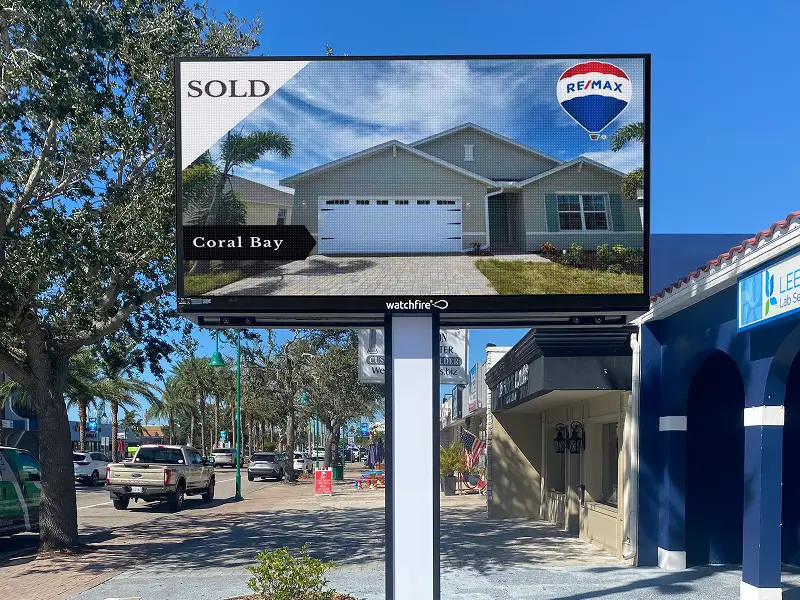
Static signs do their job, but they can’t compete with the visibility and flexibility of an illuminated LED sign or EMC (Electronic Message Center) — especially after dark or in Florida’s intense daytime sun.
A few factors drive the ROI math on an LED/EMC upgrade:
Lower operating costs. LED signage uses dramatically less energy than older neon or fluorescent sign technology, and modern LED fixtures are commonly rated for 100,000+ hours of operation — meaning a properly maintained sign can run for well over a decade before needing replacement.
Built-in advertising flexibility. With an EMC, you control the message. Promote a weekend sale on Friday, switch to a holiday hours notice on Monday, and never pay a printer or installer to do it. Businesses that rent advertising space elsewhere often find that an owned EMC pays for the message-changing flexibility alone within a season or two of regular promotions.
Higher visibility, more conversions. A bright, dynamic display in motion draws the eye in a way a static sign simply cannot, particularly at intersections, on multi-lane roads, or in shopping plazas with several competing storefronts.
Taken together, these savings and gains are why many sign providers — including our team — typically see well-designed LED signs pay for themselves within 2–3 years through energy savings and added customer traffic combined, before factoring in the brand value of having a modern, professional storefront.
See how a Sign On LED sign can pay for itself within 2–3 years. Request your free ROI estimate.
Industries Where Signage Impact Is Strongest
Not every business benefits equally from a signage upgrade — but several industries see an outsized return:
- Restaurants and quick-service food. Menu visibility, promotional pricing, and impulse decision-making (where to eat right now) make EMC displays especially effective for capturing drive-by traffic.
- Retail storefronts. With 17% of Best Buy customers reporting unplanned stops driven by signage alone, retail is where impulse-driven foot traffic is most directly measurable.
- Auto dealerships and service centers. Large lots and high-value purchases mean visibility at a distance — and credibility signaled through professional signage — carries real weight.
- Medical, dental, and professional offices. Wayfinding and trust both matter here; 68% of consumers tie sign quality to perceived service quality, which is especially relevant when patients are choosing a provider for the first time.
- Shopping plazas and multi-tenant properties. A shared EMC sign at the entrance lets multiple tenants advertise rotating promotions, multiplying the visibility ROI across every business on the property.
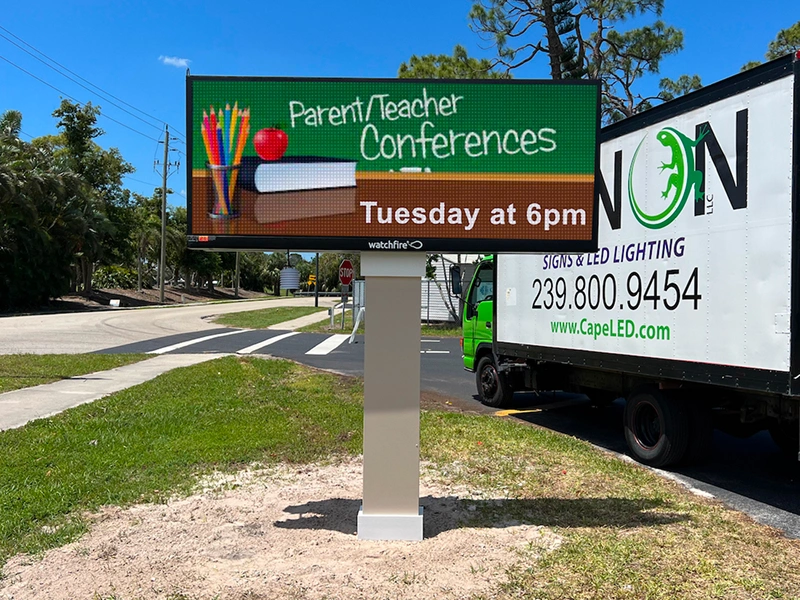
- Churches, schools, and municipalities. Announcements, event promotion, and community messaging benefit from the same always-on flexibility that retail businesses use for sales.
How to Maximize Your Sign’s Visibility in Florida’s Climate
Florida presents two unique challenges that businesses in milder climates rarely have to plan for: relentless year-round sun and brutal humidity, heat, and storm exposure. Both directly affect how well — and how long — a sign performs.
Brightness has to compete with the sun, not just the dark.
A sign rated bright enough for a cloudy Midwest afternoon may wash out completely under direct Florida sunlight. Outdoor LED displays built for Florida markets are typically rated for far higher nit output specifically to remain legible at midday, not just at night.
Materials need to survive humidity, salt air, and storm-grade wind.
Coastal and near-coastal businesses see accelerated wear on lower-grade components. Sign cabinets, electrical housings, and LED modules all need weatherproofing rated for sustained high humidity and wind exposure, not just basic outdoor use.
Pixel uniformity degrades faster in harsh climates — if the components are wrong.
Many EMC signs that look identical on a spec sheet age very differently after a Florida summer or two; lower-grade pixels can show visible color drift or “blotching” within a year or two, while properly engineered displays maintain consistent color and brightness for a decade or more.
Placement still needs to follow ISA visibility guidance.
Even the brightest sign underperforms if it’s undersized for its viewing distance or obstructed by landscaping, other signage, or building setbacks — a common issue on Florida’s wide commercial corridors.
This is exactly why sign selection in Florida shouldn’t be a one-size-fits-all decision. A range of outdoor signage options exist for businesses, including digital EMC signage and LED digital displays each designed to capture attention and drive foot traffic — but the products that actually hold up to Florida’s climate over a 5-, 10-, or 20-year lifespan are a much shorter list than the products available on the market. Working with a provider who specializes in EMC signs with proven ROI in Florida conditions specifically — rather than a generic national supplier — is often the difference between a sign that performs for a decade and one that needs costly repairs within two years.
FAQ: Business Signs and ROI
Q: Does signage really increase sales, or is it just brand awareness?
Both — and the data shows it’s measurable, not just anecdotal. 60% of businesses report sales increases of 10% or more after adding or updating their sign, and 68% of consumers say they’ve made a purchase specifically because a sign caught their eye. Signage drives both immediate transactions and longer-term brand recall.
Q: How much foot traffic can a new sign realistically generate?
It varies by location and traffic volume, but research has found that roughly 17% of customers at a given store hadn’t planned to stop until they noticed the signage — meaning a meaningful share of any storefront’s traffic is sign-driven impulse visits, not pre-planned trips.
Q: Is an LED or EMC sign worth the upfront cost?
For most businesses on a visible road or in a high-traffic plaza, yes. Beyond the foot-traffic gains, LED signage’s lower energy use and long operational lifespan (commonly 100,000+ hours) mean the upgrade frequently pays for itself within 2–3 years, even before counting the additional revenue from increased visibility.
Q: Do digital EMC signs actually outperform static signs?
Generally, yes, for businesses that benefit from changeable messaging — restaurants, retailers running promotions, multi-tenant plazas, and service businesses with seasonal offers all see more value from an EMC’s flexibility than a static sign can offer, since the message can be updated instantly without reprinting or reinstalling.
How do I know if my current sign is hurting my business? A few warning signs: faded or dim lighting that’s hard to see at night, lettering too small to read from the road at normal driving speed, or a design that hasn’t been updated in years. 61% of consumers say they’ve failed to find a business because the sign was too small or unclear — if that sounds like your storefront, a visibility audit is a reasonable first step.
Will my sign hold up in Florida’s heat and storms?
Only if it’s built for it. Many signs that perform well in moderate climates degrade quickly under intense UV exposure, humidity, and coastal wind. Choosing components specifically engineered for Florida conditions — rather than a generic national product — is the deciding factor in whether a sign still looks sharp in year five or ten.
Ready to see what the right sign could do for your foot traffic and revenue? Get a sign that drives results — Sign On LLC designs, fabricates, and installs LED and EMC signage built specifically for Florida’s climate, backed by a team that’s been showing up for Florida businesses for years.