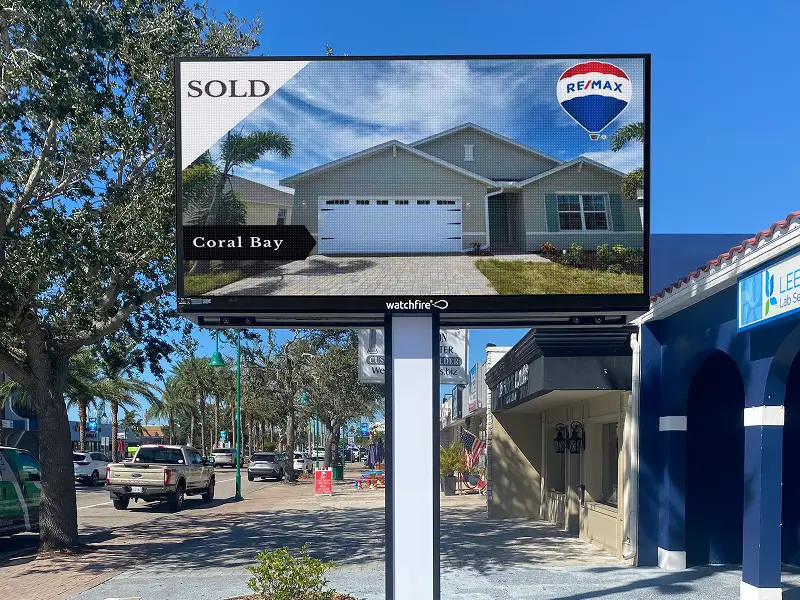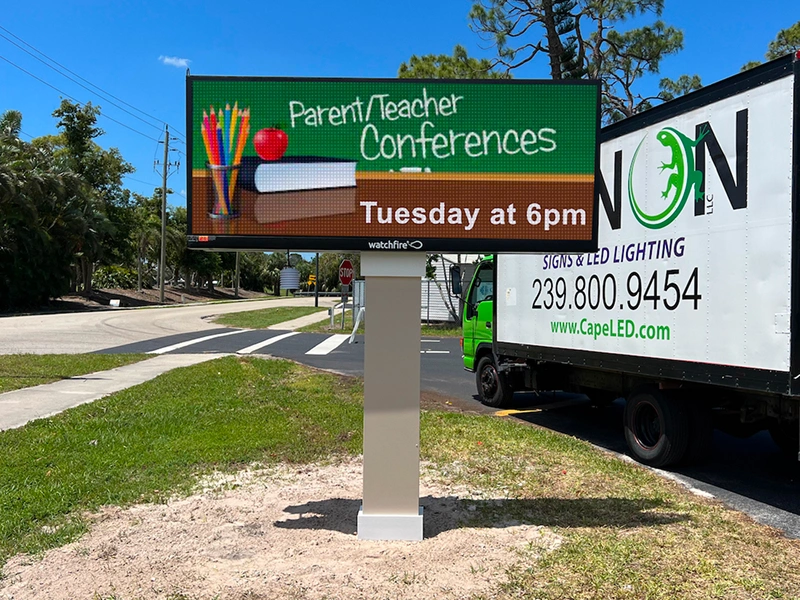
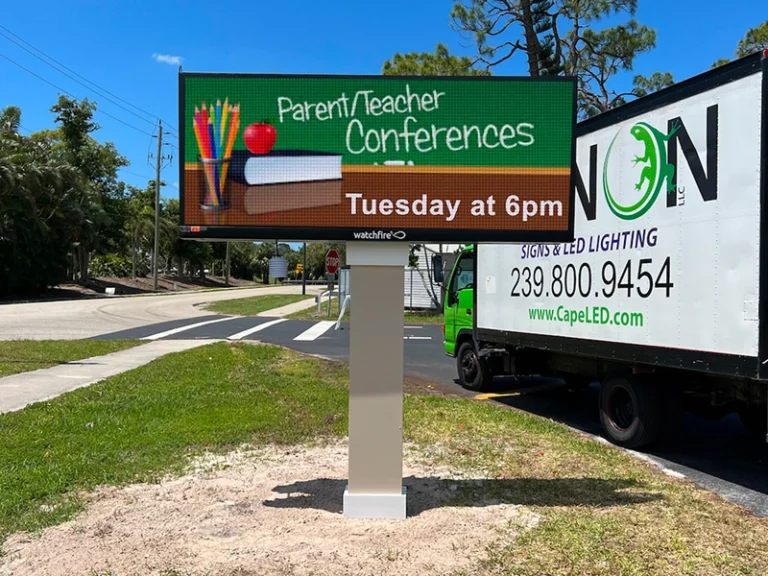
An EMC (Electronic Message Center) is a type of LED sign — one built to change its message electronically. A traditional or “static” LED sign uses the same diode technology but displays one fixed message until someone physically replaces it. If you need to update pricing, promotions, or hours regularly, an EMC almost always delivers better ROI. If your message rarely changes, a static sign can still make sense — and cost less upfront.
Trying to decide between an EMC digital sign and a traditional LED sign? This guide breaks down the real differences in cost, flexibility, visibility, maintenance, and long-term ROI so business owners can make the right investment. Learn how Electronic Message Centers (EMCs) allow instant message updates, stronger customer engagement, and greater promotional power compared to static LED signage. Discover which option works best for restaurants, retail stores, schools, churches, gas stations, and local businesses—especially in Florida’s demanding climate. Whether your goal is branding, increasing foot traffic, or maximizing advertising value, this complete comparison explains what to expect before you buy.
Here’s the comparison most sign companies won’t give you straight, because most of them only sell one or the other.
| EMC Digital Sign | Traditional/Static LED Sign | |
|---|---|---|
| Upfront cost | Higher | Lower |
| Message updates | Instant, remote, unlimited | Requires a sign technician or physical swap |
| Best for | Restaurants, retail, auto, gas/convenience, churches, schools | Businesses with one consistent message (logo, name, hours) |
| Typical ROI window | 6–18 months | N/A (no revenue-driving update capability) |
| Energy use | Slightly higher (more diodes, control system) | Lower |
| Lifespan | 8–10+ years (quality brands like Watchfire) | 8–10+ years |
| Maintenance | Remote diagnostics, minor module upkeep | Minimal, but costly to “update” |
If you only read one section, read the table above — but the details below explain why the numbers shake out this way, and which option actually fits your business.

What Is an EMC (Electronic Message Center) Sign?
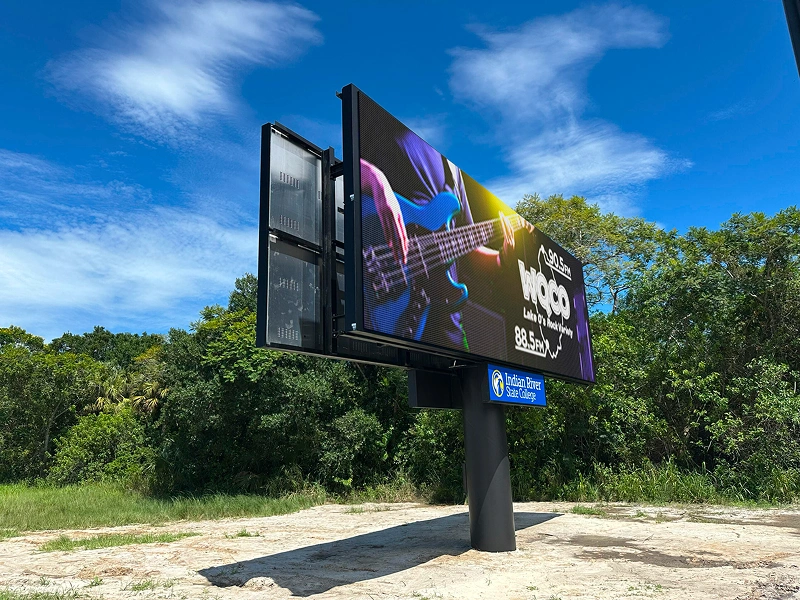
An EMC is a digital sign built from clusters of red, green, and blue LED diodes that can be programmed to display text, graphics, animations, or full video. EMCs are a specific subset of LED signs — the term EMC is generally reserved for on-premise signs that businesses use, while “LED sign” can refer to any sign using LED technology. In practice, when people say “EMC,” they mean a sign you can update from a computer or app without anyone touching the actual hardware.
The resolution of an EMC is determined by pixel pitch — advanced EMCs can use pixel pitches as small as 6mm for ultra-sharp displays, while signs viewed from highway distances often use a wider pitch like 16mm or 20mm, which is more cost-effective without sacrificing legibility from far away.
What makes an EMC valuable isn’t the hardware — it’s the control. An EMC gives a business complete control over its message, with the flexibility to schedule different content for different times of day, react to current events, or test multiple promotions to see what performs best. Think of it as a sign that works like a 24-hour employee: it never stops promoting your business, and you can change what it’s saying as often as you want, at no extra cost per update.
A well-built outdoor EMC also has to survive real weather. In Florida specifically, heat, humidity, and UV exposure are brutal on cheaper LED components — which is a major reason sign quality varies so much between brands (more on that in the cost section below).
What Is a Traditional LED Sign?
A traditional LED sign — sometimes called a static sign — uses the same basic diode technology as an EMC, but it’s built or programmed to display one fixed message: a logo, a business name, store hours, or a single graphic. Some static signs use LEDs purely for backlighting or illumination rather than for a changeable display at all.
The appeal is simplicity. There’s no software to learn, no content to manage, and a lower upfront price tag since you’re not paying for a control system, full-color matrix, or remote programming capability. Some EMCs themselves are even set to maintain a steady image that doesn’t change — useful for businesses that just want to display consistent information like store hours or a logo, using EMC hardware in static mode.
The tradeoff is flexibility. If your hours change, you run a seasonal promotion, or you want to advertise a new menu item, a static sign means a new sign — not a new message. Before EMCs existed, business signs had fixed messages that were hard to update, and you essentially had to replace the whole sign just to change what it said. A static LED sign inherits that same limitation, even though the lighting technology is modern.
Why More Businesses Are Switching to EMC Digital Signs
Businesses today need flexibility. EMC signs allow owners to change promotions, pricing, announcements, and seasonal messaging instantly without replacing physical sign panels. This level of control helps businesses stay visible and competitive.
EMC vs Traditional LED Signs: Which Delivers Better Long-Term Value?
While static LED signs cost less initially, EMC signs often provide stronger long-term value through unlimited content updates and greater customer engagement. Comparing ownership cost over several years gives a clearer picture than installation cost alone.
Key Features That Separate EMC Signs from Static Displays
EMC signs offer remote management, scheduling tools, animations, and multiple content layouts. Traditional LED signs focus on consistent branding and fixed messaging with minimal maintenance requirements.
How Digital Signage Influences Customer Decisions
Drivers and pedestrians make decisions quickly. Dynamic content naturally attracts more attention than fixed messaging, helping businesses communicate offers and encourage immediate action.
Understanding Pixel Pitch and Sign Visibility
Pixel pitch affects how sharp and readable an EMC display appears. Smaller pixel pitch improves close-range viewing, while larger pitch delivers cost efficiency for roadside and highway applications.
Remote Content Management: The Biggest Advantage of EMC
One of the biggest advantages of an EMC is the ability to update content from a computer or mobile device. Businesses can schedule messages by time, season, events, or special promotions.
Common Mistakes Businesses Make When Choosing Signage
Many businesses focus only on upfront price and ignore operating value. Choosing a sign without considering future marketing needs often leads to replacement costs sooner than expected.
Weather Resistance: Choosing a Sign for Florida Conditions
Outdoor signage must withstand heat, humidity, storms, and UV exposure. High-quality materials and reliable LED components make a major difference in long-term performance and appearance.
Installation and Permit Considerations Before Buying
Before installation, businesses should review local zoning requirements, electrical needs, mounting options, and permitting rules to avoid delays and unexpected costs.
Financing Options for EMC and LED Signs
Financing allows businesses to spread investment costs while benefiting from improved visibility immediately. Many companies find monthly payments easier to justify when tied to increased exposure.
How to Calculate Sign ROI for Your Business
To estimate ROI, compare projected increases in customer traffic and sales against installation and operating costs. Even small gains in daily revenue can significantly impact yearly performance.
Best Industries for Electronic Message Center Signs
Restaurants, retail stores, automotive businesses, schools, churches, and convenience stores often benefit most because they rely on frequent updates and promotional visibility.
When a Traditional LED Sign Is Still the Smarter Choice
If your business messaging rarely changes and your goal is permanent branding, a traditional LED sign may provide excellent value without the additional investment in digital controls.
EMC Content Ideas to Increase Customer Engagement
Use rotating promotions, event announcements, customer reminders, seasonal messages, community updates, and branded visuals to keep content fresh and noticeable.
The Hidden Costs of Static Sign Updates
Static signs may appear affordable initially, but updating promotions often requires new production, labor, and installation costs that add up over time.
Future Trends in LED and EMC Sign Technology
Modern signage continues moving toward better brightness control, improved energy efficiency, remote diagnostics, and smarter content scheduling capabilities.
EMC vs. LED: Head-to-Head Comparison Table
| Factor | EMC Digital Sign | Static LED Sign |
|---|---|---|
| Content flexibility | Unlimited message changes, scheduled by time/day | One fixed message |
| Speed to update | Instant, from a phone or computer | Days to weeks (requires new sign panel) |
| Cost to change message | $0 after install | New production + installation cost each time |
| Visibility/attention | Roughly 63 percent of people notice LED EMC displays, according to industry research | Noticed once, then becomes “wallpaper” |
| Best use case | Promotions, daily specials, events, community messages | Branding, logo display, fixed info |
| Upfront investment | Higher (control system, software, full matrix) | Lower |
| Financing payback | Often offset by revenue increase within months | No direct revenue mechanism |
| Florida durability (heat/humidity/UV) | Varies significantly by brand — Watchfire-grade signs hold up best | Generally simpler, fewer points of failure, but no content benefit |
This table is the short version. The next two sections cover who actually benefits from the upgrade, and what the real numbers look like.
Which Type of Business Benefits Most from an EMC Sign?
Not every business needs a digital message center, but most businesses with regular customer turnover, promotions, or time-sensitive offers see a fast return. EMCs tend to suit local businesses like restaurants, coffee shops, hair salons, auto repair shops, hardware stores, and nail salons — basically any business where a passing driver might decide, in a few seconds, to stop in.
That window of attention is smaller than most owners assume. A motorist driving 45 miles per hour, passing a sign 500 feet away, has only about 7.6 seconds to read it before it’s gone — which is exactly why movement and changing content outperform a static message. Drivers notice an EMC more quickly than a static sign because the content is illuminated and changing.
EMCs tend to deliver the strongest ROI for:
- Restaurants and QSRs — daily specials, limited-time offers, happy hour
- Retail and auto dealers/repair shops — seasonal sales, service specials, inventory promotions
- Gas stations and convenience stores — price changes, fuel promotions
- Churches and schools — event announcements, service times, community messaging
- Multi-tenant plazas — mall and plaza owners commonly purchase an EMC and rent display space to their tenants
A static LED sign still has a place — a standalone logo sign, a directional sign, or a business with a genuinely unchanging message (a law firm name, a building address) doesn’t need programmable content. But for businesses competing on visibility and same-day offers, the static option leaves real revenue on the table.
There’s also a competitive angle smaller businesses underestimate. An EMC allows small businesses to compete against larger companies with much bigger advertising budgets by giving them a 24/7 advertising channel that doesn’t require buying new media space every time the message changes.
Cost and ROI: What to Expect from Each Option
This is where the comparison gets concrete — and where most “EMC vs. LED” content online stays vague.
Static LED signs
cost less to install because you’re paying for illumination, not a programmable matrix or control software. There’s no software learning curve and effectively no ongoing content cost — but there’s also no revenue mechanism built in. The sign communicates the same thing in month 24 that it did on day one.
EMC signs
cost more upfront, but the data on revenue impact is what makes the math work for most businesses. The U.S. Small Business Administration has noted that businesses who add an electronic message display typically see a business increase of 15% to 150%. Even using the conservative end of that range, the math adds up fast: a business generating $1,000 in daily revenue that sees just a 15% increase nets roughly $150 more per day — about $54,600 per year.
Separate research backs the same direction. A University of Cincinnati Economics Center study found 60 percent of surveyed Ohio business owners reported a 10 percent increase in sales after adding outdoor signage that clearly communicated their business’s message.
Quality matters more for EMCs than it does for static signs, because an EMC has more components that can fail — and in Florida’s climate, that’s not a small detail. Heat, humidity, and constant UV exposure age cheap LED diodes quickly; pixel discoloration and dimming within a year or two is common with budget EMC brands in this climate. That’s the main reason we steer Southwest Florida customers toward Watchfire over lower-cost alternatives — the underlying technology category (EMC vs. static) matters less than build quality once you’re in a harsh outdoor environment.
For most businesses that invest in a quality EMC, the revenue increase from better visibility covers the financing payment within the first year — at which point the sign is generating net additional revenue, not just covering its own cost.
Want to see what this looks like for your specific business? explore our EMC digital signs to compare models, sizes, and financing options.
FAQ: EMC vs. Traditional LED Signs
Q: Is an EMC just a type of LED sign, or something different?
An EMC is a type of LED sign — specifically, one designed to change its message electronically. All EMCs use LED technology, but not all LED signs are EMCs. A static LED sign uses the same diodes for illumination or a fixed display, without the programmable content layer.
Q: How much more does an EMC cost compared to a static LED sign? EMCs cost more upfront because they include a full-color LED matrix, a control system, and content management software. The exact gap depends on size and resolution, but for most small to mid-sized businesses, the difference is typically recovered through increased revenue well within the first one to two years.
Q: Can I change a static LED sign’s message later?
Only by physically replacing the sign face or panel. That’s the core tradeoff: lower upfront cost, but no ability to update content without a new production and installation cost each time.
Q: Which option is better for a small business on a tight budget?
If your budget only covers a static sign right now, it’s still better than no illuminated signage at all. But if your business runs any kind of promotion, special, or seasonal offer, financing a smaller EMC is usually a better long-term investment than a static sign you’ll want to replace within a few years anyway.
Q: How long does an EMC sign last?
A quality EMC from a manufacturer built for harsh climates — Watchfire is the standard we recommend for Florida — typically performs reliably for 8–10+ years. Lower-cost brands often show visible pixel aging within 1–2 years in Florida’s heat and humidity, even if the sign itself keeps functioning.
Q: Do EMC signs actually increase foot traffic and sales?
National research consistently points that direction. The SBA has cited revenue increases of 15–150% for businesses adding electronic message displays, and independent university research has found similar double-digit sales increases tied to improved outdoor signage. Results vary by industry, location, and message quality, but the data trend is consistent.
Sign On is Southwest Florida’s #1 Watchfire dealer.
Whether you’re comparing an EMC to a static sign for the first time or upgrading from an aging display, we’ll help you find the option that fits your budget and your business. See EMC options that fit your budget →
Have questions about financing, sizing, or permitting for your location? Get an EMC sign quote or learn more about Watchfire EMC signs and why they’re the gold standard for Florida’s climate.