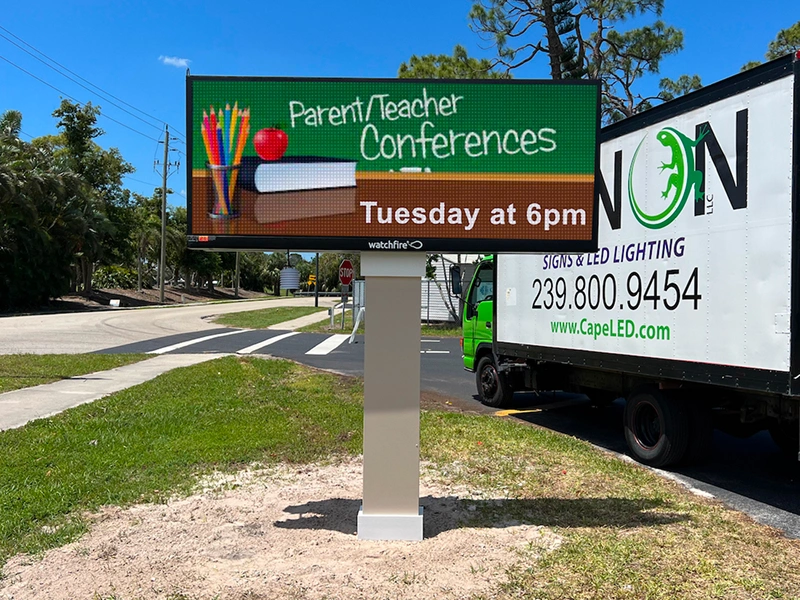
LED signs have become the preferred choice for businesses looking to maximize visibility, reduce energy costs, and create a professional brand presence. Compared to traditional neon and fluorescent signage, modern LED signs offer superior brightness, lower maintenance requirements, and significantly longer operational life. But one of the most common questions business owners ask is: How long do LED signs actually last?
The answer depends on several factors, including the quality of the components, daily operating hours, environmental conditions, and maintenance practices. For businesses in Florida, additional challenges such as extreme heat, humidity, UV exposure, and coastal salt air can also impact sign longevity.
In this guide, we’ll break down the average lifespan of commercial LED signs, explain the factors that affect their performance, discuss when repair or replacement makes sense, and provide practical tips to help you get the maximum return on your signage investment. Whether you’re considering a new installation, evaluating an aging sign, or planning an upgrade to digital signage, understanding LED sign lifespan can help you make a smarter business decision.
Modern LED signs last 80,000–100,000 hours of operation — roughly 11–17 years of continuous use, or 25+ years if used 8 hours a day. Quality components, Florida heat, and maintenance practices determine where in that range your sign lands.
Key Takeaways
- LED sign lifespan: 80,000–100,000 hours rated operational life
- Real-world lifespan: 10–20+ years depending on daily usage and climate
- Break-even ROI: Most businesses recover their investment in 2–4 years via energy savings
- Florida factor: Heat, humidity, salt air, and UV can shorten lifespan by 15–25% without proper enclosure ratings
- Replace vs. repair threshold: When repair costs exceed 50% of replacement value, it’s time to replace
- Best lifespan extender: Voltage surge protection + regular cleaning + firmware updates
How Long LED Signs Actually Last
The LED industry uses a measurement called L70 — the point at which an LED’s brightness drops to 70% of its original output. That threshold is typically reached at 80,000–100,000 hours for commercial-grade LEDs.
Here’s what that means in practical terms:
LED Sign Lifespan vs. Hours of Daily Use
| Hours of Use Per Day | Years to L70 (80,000 hrs) | Years to L70 (100,000 hrs) |
|---|---|---|
| 24 hours (continuous) | ~9 years | ~11.4 years |
| 18 hours/day | ~12 years | ~15 years |
| 12 hours/day | ~18 years | ~22.8 years |
| 8 hours/day | ~27 years | ~34 years |
| 6 hours/day | ~36 years | ~45 years |
Most businesses operate their signs 10–16 hours per day, putting practical lifespan in the 14–22 year range for quality signs. That’s three to four times longer than traditional neon or fluorescent cabinet signs.
Note: The L70 rating doesn’t mean the sign stops working — it means visible brightness has dimmed. Many signs remain functional and readable well beyond this threshold.
What Determines LED Sign Lifespan?
Not all LED signs are created equal. Five factors have the greatest impact on where your sign lands in that 80,000–100,000 hour range:
1. LED Chip Quality Commercial-grade LEDs from top-tier manufacturers (Cree, Nichia, Epistar) are binned and tested to tighter tolerances than budget chips. Cheaper signs often use lower-bin LEDs that dim faster and develop dead zones sooner.
2. Driver Quality The LED driver converts AC power to the precise DC voltage LEDs need. Cheap drivers run hotter, degrade faster, and introduce voltage fluctuations that stress the chips. Driver failure is one of the top causes of premature LED sign death.
3. Heat Dissipation Design Heat is the enemy of LED longevity. Well-designed signs use aluminum heat sinks, adequate cabinet ventilation, and thermal management systems. A sign that runs 10°C cooler can last 30–50% longer — this is basic LED physics (the Arrhenius equation applied to semiconductor degradation).
4. Hours of Operation As the table above shows, the fewer hours per day you run your sign, the longer it lasts. A sign used only during business hours will outlast a 24/7 display by decades.
5. Installation Environment UV exposure, temperature swings, moisture intrusion, and airborne contaminants all accelerate degradation. This is where Florida becomes a particularly important variable.
Florida-Specific Lifespan Factors
Florida business owners face a unique combination of environmental stressors that can meaningfully shorten LED sign lifespan if not properly addressed at the time of installation.
Extreme Heat and Humidity Florida summers routinely push ambient temperatures above 95°F, which can push internal cabinet temperatures to 130°F or higher on south-facing signs without adequate ventilation. Each 10°C increase in operating temperature roughly halves the lifespan of semiconductor components. Look for signs rated to operate in high ambient temperatures — at minimum IP65-rated enclosures.
Salt Air (Coastal Locations) Businesses within 5–10 miles of the coast face corrosive salt spray that attacks metal components, corrodes circuit boards, and degrades connector contacts. Marine-grade conformal coating on PCBs and stainless steel or coated aluminum hardware dramatically extend sign life in these environments.
UV Radiation Florida receives some of the highest UV index readings in the continental US. UV breaks down plastic diffusers, degrades wire insulation, and accelerates color shift in lower-grade LED chips. UV-stabilized cabinet materials and UV-resistant polycarbonate faces are worth the premium here.
Hurricane and Storm Stress Even signs that survive a storm intact may suffer from vibration-loosened connections, water intrusion through compromised seals, and voltage spikes from power restoration events. A post-storm inspection from a qualified sign technician is good practice after any major weather event.
Florida business owners who invest in properly rated signs — and maintain them properly — typically see lifespan at the higher end of the range. Those who buy based on lowest upfront price often replace signs in 7–10 years rather than 15–20.
LED Sign ROI Timeline — Year-by-Year Energy Savings
The ROI case for LED signs is straightforward. A standard 4′ × 8′ illuminated cabinet sign using fluorescent lamps draws roughly 500–800 watts. An equivalent LED sign draws 150–250 watts — a 60–75% reduction in energy consumption.
Sample ROI Timeline (Small Business LED Cabinet Sign)
| Year | Cumulative Energy Savings | Notes |
|---|---|---|
| Year 1 | ~$400–$600 | Savings begin immediately |
| Year 2 | ~$800–$1,200 | Savings compound with utility rate increases |
| Year 3 | ~$1,200–$1,800 | Typical break-even on smaller signs |
| Year 4 | ~$1,600–$2,400 | Full ROI reached for most installations |
| Year 5 | ~$2,000–$3,000 | Pure savings — no maintenance costs yet |
| Years 6–15 | $3,000–$9,000+ | Long-term savings accumulate |
Estimates based on 12 hours/day operation, $0.12/kWh average Florida utility rate. EMC digital signs have higher upfront costs but greater advertising revenue potential.
For EMC (Electronic Message Center) digital signs, the ROI calculation also includes the elimination of banner printing costs, reduced need for physical advertising changes, and the ability to run time-sensitive promotions — see how EMC digital signage works.
The U.S. Department of Energy’s lighting research confirms that LED commercial lighting products — including signage — deliver a positive ROI within 2–5 years in most commercial applications, with energy cost reductions of 50–75% compared to legacy technologies.
5 Warning Signs Your LED Sign Needs Replacement
These symptoms indicate your sign may be approaching end of life — or may need professional evaluation immediately:
1. Significant Dimming or Uneven Brightness If your sign is visibly dimmer than it used to be, or has sections that are brighter or darker than others, the LEDs are aging unevenly. Once brightness drops below 50–60% of original output, the sign is becoming less effective as an advertising tool.
2. Dead Pixels or “Swiss Cheese” Sections Individual LED failures that create dark spots or dead zones in your sign indicate driver or LED chip failure. Small clusters are repairable; large areas or spreading failures suggest systemic degradation.
3. Color Shifting White LEDs that appear yellow, pink, or green have undergone phosphor degradation. Color-specific LEDs (red, blue, green) that look “off” compared to when the sign was new have experienced wavelength drift. This is irreversible and affects sign readability and brand perception.
4. Frequent Electrical Issues or Flickering Flickering, unexpected shutdowns, or circuit breaker trips point to driver failure or moisture-related electrical problems. These can escalate to safety hazards and should be inspected promptly by a qualified technician offering professional sign repair services.
5. Physical Cabinet Deterioration Cracked faces, rust streaks, peeling paint, warped panels, or visible water damage inside the cabinet create moisture pathways that accelerate component failure. When the cabinet is compromised, even new LED components won’t reach their rated lifespan.
Repair vs. Replace — When Each Makes Sense
The 50% rule is a useful starting point: if repair costs exceed 50% of the cost of a comparable new sign, replacement is usually the better long-term investment.
Repair makes sense when:
- The sign is under 8–10 years old
- Failure is isolated to one driver, one section, or one component
- The cabinet and face are in good structural condition
- Repair cost is under 30–40% of replacement value
- The sign’s technology is still current (resolution, brightness)
Replace when:
- The sign is 12+ years old with multiple failing areas
- Replacement parts are discontinued or hard to source
- The cabinet has structural or weather-seal failures
- Total repair estimates exceed 50% of new sign cost
- Your business needs have changed (bigger size, digital capability)
- You want to upgrade to EMC/digital for greater advertising flexibility
When in doubt, get a professional assessment. A qualified sign technician can tell you whether you’re dealing with an isolated repair or a sign that’s in systemic decline.
How to Extend Your LED Sign’s Life
These four practices have the highest impact on reaching the top end of the lifespan range:
Install Surge Protection Voltage spikes — from lightning, grid switching, or HVAC equipment — are a leading cause of premature driver and LED failure. A quality surge protection device (SPD) on the sign’s dedicated circuit is one of the most cost-effective investments you can make. Cost: $50–$200 installed. Benefit: potentially years of added life.
Clean Regularly Dust and dirt on sign faces block light output and cause the sign to run brighter (and hotter) to compensate. Dirt inside vented cabinets can clog heat sinks. Clean the exterior monthly and inspect interior ventilation openings annually. See our complete guide on best outdoor signage maintenance practices for a full checklist.
Keep Firmware and Controllers Updated Modern LED signs — especially EMC digital displays — use software to manage brightness, temperature, and operating schedules. Firmware updates often include thermal management improvements that reduce heat stress. Outdated firmware can cause signs to run at maximum brightness 24/7, dramatically shortening component life.
Set Appropriate Brightness Schedules Running a sign at 100% brightness in all conditions is unnecessary and wasteful. A sign operating at 70% brightness in ambient daylight conditions will last measurably longer than one always maxed out. Many controllers support photocell-based auto-dimming — a worthwhile feature to enable if you have it.

Cost of Replacement vs. Refurbishment
For business owners weighing options, here’s a general cost framework for the Florida market:
| Option | Typical Cost Range | Best For |
|---|---|---|
| Component repair (single driver/section) | $200–$800 | Signs under 10 years old, isolated failure |
| Full LED retrofit (existing cabinet) | $800–$3,500 | Solid cabinet, outdated light source |
| Full sign replacement (standard lit cabinet) | $2,500–$8,000 | Aging cabinet, outdated design |
| EMC/Digital sign replacement | $8,000–$40,000+ | Maximum advertising flexibility, long-term ROI |
| EMC module replacement | $1,500–$6,000 | Functional cabinet, failed pixel sections |
Pricing varies based on sign size, mounting complexity, permitting requirements, and electrical work needed.
Explore LED lighting options and our full services for a consultation specific to your sign and location.
Ready to evaluate your current sign or explore replacement options? View our services or explore EMC digital signage for Florida businesses
Conclusion
LED signs are one of the most durable, energy-efficient, and cost-effective advertising investments a business can make. With a lifespan of 80,000–100,000 hours, quality LED signage can provide reliable visibility for 15–25 years or more when properly maintained. However, factors such as installation quality, component selection, daily operating hours, and Florida’s challenging climate conditions all play a role in determining how long your sign will perform at its best.
Regular maintenance, surge protection, proper brightness settings, and timely repairs can significantly extend the life of your investment while maximizing your return on investment. Whether you’re evaluating an aging sign, planning an LED retrofit, or considering a new EMC digital display, understanding the true lifespan and long-term costs of LED signage helps you make informed business decisions.
If you’re unsure whether your current sign should be repaired, upgraded, or replaced, the experts at Sign-On LLC are here to help. We provide professional sign inspections, LED retrofits, sign repairs, EMC digital signage solutions, and custom sign installations throughout Florida.
📞 Phone: 239-800-9454
Our team can assess your existing signage, recommend the most cost-effective solution, and help your business stay visible day and night with high-performance LED signage built for Florida conditions.
Contact Sign-On LLC today to schedule a consultation and discover the best signage solution for your business.
Frequently Asked Questions
Q: How long do LED signs last in hours?
Commercial-grade LED signs are rated for 80,000–100,000 hours to L70 (70% of original brightness). This translates to 9–11 years of continuous 24/7 operation, or 25–34 years at 8 hours per day.
Q: What is the lifespan of a business LED sign?
For most businesses operating signs 10–14 hours per day, a quality LED sign will last 15–22 years before requiring significant refurbishment or replacement. Budget signs may require replacement in 7–10 years.
Q: How do I know when to replace my LED sign?
The five clearest indicators are: significant dimming or uneven brightness, dead pixel sections, color shifting, frequent flickering or electrical issues, and physical cabinet deterioration. If you’re seeing two or more of these, have a professional evaluate whether repair or replacement makes more economic sense.
Q: Do LED signs save money compared to neon or fluorescent?
Yes — LED signs typically use 60–75% less energy than fluorescent cabinet signs and 80–90% less than neon. Most businesses recover this difference within 2–4 years through energy savings alone, before accounting for reduced maintenance costs.
Q: How does Florida heat affect LED sign lifespan?
Heat is the primary enemy of LED longevity. Florida’s high ambient temperatures can push internal cabinet temperatures to levels that accelerate component degradation. Properly ventilated, IP65-rated enclosures and surge protection help offset this. Signs without adequate thermal management may last 30–40% fewer hours than their rated lifespan.
Q: Can LED signs be repaired, or do they need to be fully replaced?
Most LED signs can be partially repaired — individual drivers, LED modules, and control systems are often replaceable. Full replacement makes more sense when the cabinet is structurally compromised, parts are discontinued, or the total repair cost exceeds 50% of new sign value.
Q: How long do LED signs last outdoors vs. indoors?
Indoor LED signs, protected from weather, UV, and temperature extremes, often outlast their outdoor counterparts by 20–30%. Outdoor signs in harsh climates like Florida face additional stressors that can reduce practical lifespan. Proper enclosure ratings (IP65 or higher for outdoor) help bridge this gap.
LED Sign Financing Options for Small Businesses in Florida: What’s Available and How to Apply