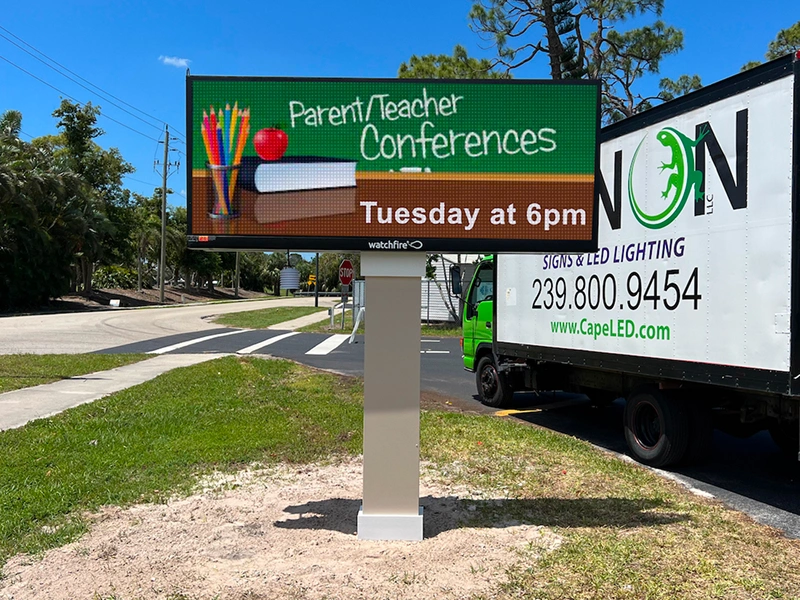

Your EMC Electronic Message Center is one of the hardest-working pieces of equipment your business owns. It runs around the clock, through rain, heat, freezing temperatures, and everything in between — quietly pulling customers through your door while you focus on running your operation.
But like any piece of technology that never gets a day off, your EMC will eventually start showing cracks. And here’s the thing most business owners don’t realize until it’s too late: an electronic message center almost never fails without warning. The warning signs are there. They’re just easy to brush off as “minor quirks” — until you show up one morning and your sign is completely dark.
At Sign On LLC, we’ve seen this happen more times than we can count. A business owner waits too long, and what could have been a simple $200 service call turns into a $2,000+ emergency repair — or worse, a full cabinet replacement. That’s money nobody wants to spend, and downtime nobody can afford.
So let’s talk about the five signs your EMC Electronic Message Center is trying to tell you it needs attention. Catch these early and you’ll save yourself a serious headache.
The 5 Warning Signs
Flickering or Dimming Pixels That Come and Go
You might notice it first thing in the morning or when driving past your sign at night — a section that looks dimmer than the rest, or individual pixels that seem to flicker like a bad light bulb. Maybe it only happens in certain temperatures, or only when the sign is displaying a particular color. You figure it’s just a “glitch,” and half the time it looks fine. So you leave it alone.
That’s exactly how power supply failures begin. When a power supply unit inside your EMC starts degrading, it often delivers inconsistent voltage to specific LED modules. Those modules flicker under load, then seem to recover. Over time, the affected area grows. Then one day, that entire section of your sign goes dark permanently — because the power supply finally gave out completely.
A skilled sign technician can run a diagnostic on your power supplies and LED modules in a single visit. If one power supply is showing signs of stress, replacing it proactively is a fraction of the cost of an emergency repair — and it protects the LED modules downstream from voltage damage.
Take a short video clip on your phone the next time you see flickering and share it with your service technician. It helps them diagnose the issue faster, even before they arrive on-site.

Your Display Colors Look Off or Washed Out
LED signs are supposed to be vivid. That’s the whole point — they catch the eye from across a parking lot, even in bright daylight. So when your reds start looking orange, your whites start looking yellow, or your entire display looks like it’s been faded by the sun, something is wrong.
Color shift in an EMC Electronic Message Center usually points to one of two problems: LED module degradation or a communication issue between your controller and the display panels. Over time, the red, green, and blue LEDs inside a pixel don’t age at exactly the same rate. When one color starts fading faster than the others, you get color imbalance across the sign.
Alternatively, if the color shift happened suddenly rather than gradually, it’s more likely a data or signal problem — meaning your controller board isn’t sending the right color information to the display, or there’s a loose ribbon cable inside the cabinet creating signal interference.
Both LED degradation and controller issues are serviceable — but the key is catching them before an entire panel needs replacement. Partial LED module swaps are affordable. Wholesale panel replacements are not.
You Can’t Connect to or Update Your Sign
Modern EMC Electronic Message Centers are designed to be updated remotely — through software, Wi-Fi, or a direct connection. When that connection becomes unreliable, times out repeatedly, or stops working entirely, most business owners assume it’s a software issue and start rebooting their computer or reinstalling their sign management software.
Sometimes that’s the fix. But more often, persistent connection problems point to hardware issues inside the sign itself — a failing wireless receiver, a degraded ethernet port on the controller, or a controller board that’s on its way out. In some cases, it’s simply condensation or moisture that’s gotten inside the cabinet and is causing corrosion on the communication components.
Before calling for service, try updating your sign from a different device and a different network. If it still won’t connect, the problem is almost certainly inside the cabinet, not on your end.
At Sign On LLC, we’ve opened plenty of sign cabinets where the owner thought they had a network problem, only to find a controller board with visible corrosion, or a receiver that had been slowly dying for months. If you can’t reliably push content to your EMC, it needs to be looked at. A sign you can’t update is only marginally better than a sign that doesn’t work at all.
Do not keep forcing connection attempts to an unresponsive controller. Repeated failed writes can sometimes corrupt sign memory. Call a technician instead—professional service repair and expert installation you can trust.
Visible Physical Damage to the Cabinet or Louvers
This one sounds obvious, but you’d be surprised how many business owners walk past cracked cabinet seams, bent louvers, or impact damage on their EMC Electronic Message Center for months without acting on it. It’s easy to think “the sign still works, so it’s fine.” But physical damage to the housing is a slow-moving emergency.
Your sign’s cabinet is engineered to keep moisture, insects, and temperature extremes away from the sensitive electronics inside. Once that seal is compromised, you’re on a countdown. Water infiltration is one of the leading causes of catastrophic EMC failures — and the damage it causes is rarely limited to one component. When moisture gets inside a sign cabinet, it can corrode controller boards, short out power supplies, and destroy LED modules simultaneously.
Similarly, louver damage affects airflow. Many EMC units rely on passive or active ventilation to manage heat. When vents are blocked or broken, internal temperatures spike — and LEDs and power supplies have a well-documented inverse relationship between heat and lifespan. More heat equals faster degradation.
A cabinet repair or resealing job is straightforward and affordable when done proactively. Waiting until moisture has gotten inside and destroyed $1,500 worth of electronics is not.
Your Sign Restarts on Its Own or Shows Random Error Content
This is the one that tends to get business owners’ attention fast — because customers notice it too. Your EMC Electronic Message Center suddenly goes blank and restarts mid-message. Or it displays garbled text, random characters, or incomplete images. Or it cycles through some kind of error screen that nobody programmed into it.
Spontaneous restarts are almost always a power issue or a controller issue. Either the sign is experiencing voltage drops that cause the system to reset (often tied back to a failing power supply), or the controller board itself is malfunctioning and rebooting as a self-recovery attempt.
Random content errors — garbled text, corrupted images, or incorrect playback — usually indicate a memory problem or data corruption on the controller. Sometimes this is caused by a power surge that damaged the controller’s onboard storage. Sometimes it’s simply a failing controller that’s degraded over time.
In most cases, a controller replacement resolves random restart and content error issues completely. Controllers are a serviceable component, and at Sign On LLC, we stock replacement boards for most major EMC Electronic Message Center brands. A same-day or next-day turnaround is often possible once the issue is confirmed.
- 78%of EMC failures show warning signs at least 30 days before total failure
- 5×more expensive to replace vs. proactively repair a failing component
- 24hrsaverage downtime for a business with an unplanned sign failure

Why Preventive Service Makes Financial Sense
Here’s something the sign industry doesn’t talk about enough: an EMC Electronic Message Center that’s well-maintained can realistically last 10 to 15 years or more. One that’s neglected until it fails might make it 5 or 6 years before becoming an expensive problem.
The math is straightforward. A scheduled annual inemcspection typically runs between $150 and $350 depending on the size and complexity of your sign. That inspection will catch degrading power supplies, loose connections, early moisture intrusion, and controller irregularities before any of those become emergencies. Compare that to the cost of a controller replacement ($400–$800), a full power supply swap ($300–$600), or a major LED panel replacement ($800–$2,500+).
The business case for preventive maintenance on an EMC Electronic Message Center isn’t complicated — it’s the same logic that applies to servicing your HVAC, your vehicle, or any other piece of equipment your livelihood depends on.
What a Professional EMC Service Call Looks Like
When a technician from Sign On LLC comes out for a service visit, here’s what that actually involves: a visual inspection of the cabinet exterior and seal, an internal inspection of power supplies, controller boards, ribbon cables, and ventilation, a voltage test across all power supply outputs, a connectivity test of the communication system, a firmware check and update if applicable, and a cleaning of any dust or debris from the interior — because dust buildup on power supplies is a real and common cause of premature failure.
The whole process typically takes one to two hours for a standard-size EMC. You walk away knowing the current condition of your sign, what (if anything) needs attention, and roughly when components are likely to need replacement based on their age and performance. That kind of visibility is worth its weight in gold when you’re planning your maintenance budget.
Don’t Wait for a Dark Sign
The most common thing we hear from business owners after an emergency repair is some version of “I noticed something was off a few months ago but figured it wasn’t a big deal.” We understand — you’re running a business, not a sign shop. Noticing a flicker or a color shift is easy to put on the back burner when you’ve got a hundred other things to handle.
That’s exactly why it helps to have a relationship with a sign service company you trust. When you notice something off, you make a quick call. A technician comes out, takes a look, and either tells you it’s nothing to worry about right now — or catches something that, left alone for three more months, would have turned into an emergency repair bill and several days of lost sign visibility.
At Sign On LLC, that’s how we prefer to work with our clients. Not as a repair shop you call when everything has already gone wrong, but as a proactive partner who helps you keep your EMC Electronic Message Center running at full strength for as long as possible.
Get a free quote today and discover the perfect solution tailored to your needs!
Frequently Asked Questions:Common Questions About EMC Electronic Message Center Service
Q: How often should my EMC Electronic Message Center be professionally serviced?
For most business applications, an annual inspection is a solid baseline. If your sign runs 24/7, is in a high-traffic or high-pollution environment, or is more than five years old, twice-yearly service visits are worth considering. The older your EMC, the more likely components are approaching the end of their service life — and the more value you get from catching problems early. Outside of scheduled service, you should also call for a check any time you notice one of the warning signs covered above: flickering, color shift, connectivity problems, visible damage, or random restarts.
This depends on the age of the sign, the scope of the problem, and the overall condition of the cabinet and electronics. A 4-year-old sign that needs a controller replacement is almost always worth fixing. A 12-year-old sign with multiple failing components, a rusted cabinet, and severely degraded LEDs might be at a point where replacement makes more financial sense over the next two to three years. The honest answer is that a qualified technician needs to evaluate it in person. At Sign On LLC, we’ll give you a straight assessment — we’re not in the business of selling repairs when a replacement is the smarter long-term call, or vice versa.
Conclusion: Don’t Let Small Problems Become Big Bills
Your EMC Electronic Message Center is doing real work for your business every single day. It’s advertising for you at 2am when your team is asleep. It’s catching the eye of a new customer driving past who wouldn’t have noticed you otherwise. It’s communicating your hours, your specials, your events — all without you lifting a finger.
It deserves to be taken care of.
The five signs we covered — flickering pixels, color shift, connectivity problems, physical cabinet damage, and spontaneous restarts — are your sign asking for help before things get serious. They’re not minor quirks to brush off. They’re early warnings that a trained eye can address quickly and affordably, before they turn into the kind of failures that take your sign completely offline.
At Sign On LLC, we’ve built our reputation on being the kind of sign company that gives business owners straight answers. If your sign needs a repair, we’ll tell you what it costs and why. If it doesn’t need anything yet but will in six months, we’ll tell you that too. We don’t believe in selling work that doesn’t need to be done — but we do believe strongly in catching problems early, because we’ve seen too many times what happens when they’re left alone.
If any of the warning signs in this article sound familiar, don’t wait for the sign to go completely dark before making the call.
Ready to Schedule a Service Call?
Contact Sign On LLC today for a professional inspection of your EMC Electronic Message Center. We’ll give you an honest assessment, a clear diagnosis, and a fast turnaround so your sign is back to working at full strength.